

When people first hear terms like laser engraving and laser etching, they often assume they mean the same thing. In everyday conversation, many makers and even some shops use the words interchangeably. But while they are closely related, they actually describe different processes—and understanding the difference helps you know exactly what you’re getting when you order a custom piece.
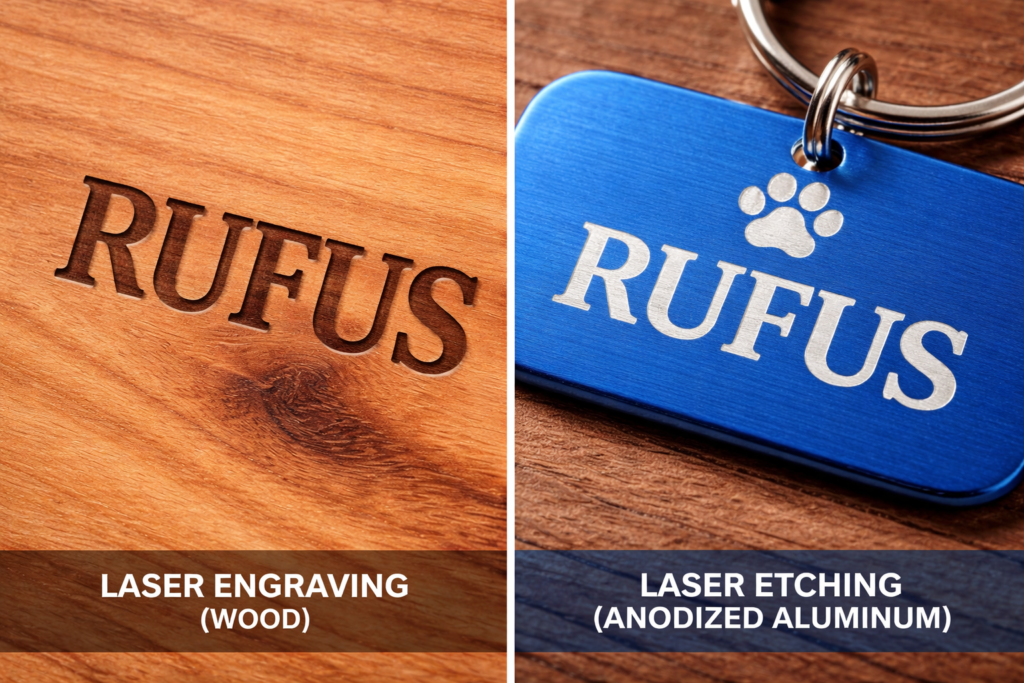
The Simple Difference: Engraving vs. Etching
In plain terms, laser engraving removes material, while laser etching changes the surface.
- Laser engraving cuts deeper into the material, physically removing a small amount to create grooves, depth, and texture you can often feel with your fingertip.
- Laser etching is much lighter. Instead of cutting deep, the laser heats the surface just enough to change its color or finish without creating noticeable depth.
Both methods are precise, permanent, and clean—but the final look and feel are different.
How This Applies to Wood
With wood products, the term laser engraving is most commonly used. The laser burns into the wood, removing material and creating a recessed design. Depending on the depth, this can range from a subtle mark to what some people call laser carving, where the engraving is deeper and more dimensional.
For example:
- A name or logo lightly engraved into cedar will appear dark and crisp, slightly recessed.
- A deeper engraving (or carving) may create shadows and texture you can clearly feel.
- Because the laser is burning the wood, engraved areas often appear darker than the surrounding surface, creating natural contrast without paint.
Wood is ideal for engraving because it responds beautifully to depth and texture, giving designs a warm, handcrafted character.
How This Applies to Metal
Metal behaves differently, and this is where the terms can get confusing.
Standard (Bare) Metal
On raw steel or stainless steel, lasers typically etch rather than deeply engrave. The laser alters the surface, creating a darker or frosted mark without removing much material. The result is smooth, clean, and permanent—but usually shallow.
Anodized Metal
Anodized aluminum (commonly used for tags, plates, and custom parts) has a colored surface coating. When a laser hits anodized metal, it removes the colored anodized layer, revealing the lighter metal underneath. This creates sharp, high-contrast markings.
Even though material is technically removed, this process is often still referred to as laser etching in everyday language because the cut is shallow. The result is smooth, precise, and extremely durable.
For example:
- A black anodized tag engraved with a laser reveals bright silver lettering.
- The surface remains smooth to the touch, even though the design is permanent.
Why the Terms Get Mixed Up
In the custom product world, the words engraving and etching are often used loosely. Many people simply say “engraved” to describe any permanent laser marking, whether it’s deep or shallow. What really matters is:
- Depth — Is the design recessed or surface-level?
- Texture — Can you feel it?
- Material — Wood, anodized metal, and raw metal all react differently.
When ordering a product, asking about depth, feel, and appearance will tell you more than the terminology alone.
What to Expect When You Order
Here’s a quick, practical guide:
- Wood products: Usually laser engraved (burned into the surface). Can be shallow or deep. Dark, natural contrast. May feel recessed.
- Anodized aluminum: Laser removes the colored coating. High contrast. Smooth to the touch. Very durable.
- Bare metal: Typically laser etched. Subtle depth. Clean, permanent marking.
- Deep wood carving: More pronounced engraving for dimensional designs.
Laser engraving and laser etching are both precise, permanent, and beautiful ways to personalize a product. The key difference is depth—engraving cuts in, while etching marks the surface. Materials like cedar wood, anodized aluminum, and raw metal each respond differently, which is why the same laser can produce very different results.
Understanding these basics helps you choose the right look, feel, and finish for your custom piece—so when your finished product arrives, it looks exactly the way you imagined.